I had the opportunity this past Thursday to spend the day observing other classes. I was told that I could observe any classes that I wanted to. The district even payed for a sub to come in and teach my classes for the day. It was a pretty sweet deal.
I could have observed a bunch of math classes but instead I chose to go through a typical day as a sophomore student at my high school. Let me tell you, it was a good choice. As a teacher, I had completely lost sight of who these people (my students) were. I see them in my class and assume that if they're disinterested in my class, they must be disinterested in general. As I went from class to class, however, it dawned on me that all of my students are just normal people (DUH!) and some of them just don't enjoy geometry or its challenges. I should say that these are things that I knew academically before but things that I now have an intuitive grasp on. Let me walk you through my day:
I started the day with a lit test. It was dull and took the entire period. Then I had geometry. We had a quiz at the end of the period there and some review before that. Then it was biology, in which we were taking the OAKS test (Oregon state science test). Some of us were finished with the test, though (we'll pretend that I was one of those students), so we went back to the classroom from the computer lab and did a little review of GATTACA. We had to think about whether we'd actually want to live in the GATTACA universe. It was nice to have the opportunity to think openly and critically about something. I mean, it was nice to be able to openly express my opinion about something. Then I had social studies. We were watching a movie called Walk Out. It's about a bunch of Latino students in LA who staged a walk out in the MLK/Viet Nam era of activism in order to procure a better education for themselves. Movies are so nice. Then lunch and then my day ended with French II. French was clearly the best class of the day. It was fun, a little crazy, and kept me on my toes. We made French haikus.
One thing that really stuck with me is how much I don't like these short periods. I didn't feel like I actually had a complete lesson in any of my classes. Admittedly, I was testing in most of them. Still, even in the social studies and French classes, the lessons were a clear beginning. I think we may have gotten into the middle? But we certainly did not get to the ending. It was frustrating as a student. It was going to a class, starting a thought and then, before being able to complete that thought, going to another class to start another thought.
How will this experience change how I will teach my class, you ask? I doubt it will have much real impact, actually. Some would say that that would make it a waste of a day, a waste of the substitute's time, and a waste of the taxpayers' money. I don't think it's a waste at all. I spent a day getting to better know the world of my students. That gives me the capacity to be more appropriately compassionate, understanding, & reliable to them. That's not a waste at all.
Sunday, March 17, 2013

Monday, March 4, 2013
Teaching
Yeah, that's a general post title. At the time of this writing, I'm at a dance workshop. The workshop leader is a young woman who is clearly a very good dancer. Problem is, she's not a great teacher.
She's teaching about shifting momentum from the lead to the follow. Watching her teach has renewed my respect for my profession. There have been several occasions during which I have thought of something I want to interject that could help her instruct her students. She keeps mentioning that the follow needs to use the lead's momentum. She never explains what that means though. I suppose it's supposed to be common knowledge. But it is clear that not everyone does.
Some of the dancers are not following some of her basic instructions. She's explaining what they ought to be doing but not providing specific enough feedback for her students to realize what they're doing wrong. I should say that I'm not a dancer and I would not be able to do what these dancers are trying to do. But I can see that some of the dancers are not doing what she was doing exactly.
This is happening in part due to not adequately assessing the dancers' performance.
I just wanted to share this because its pointing out to me how much better learning is if we do our jobs well: adequately assess, provide specific feedback.
That said, the dancers are getting the moves. They're getting it through practice, specific conversations about the moves, and determination to get it right. That said, the dancers who are better listeners and observers are getting better at the moves more quickly than those who are not.
That is all.
Thursday, February 21, 2013
A night off?!?
Night off
This is the first evening all year when I haven't had grading or other work to do. On top of that, my room mate is away for a job interview in Wisconsin (good luck Melissa!). So I'm home alone with pretty much nothing to do but blog about how glorious this night is. So glorious.
Quiz tomorrow
Tomorrow we're giving our first assessment for the quadrilaterals unit. I'm not totally in love with the assessment but it'll get the job done. I think some of my students will even do reasonably well on it. Actually, given data from past years (last year I witnessed it and the other geometry teachers have seen it year after year), this will probably be the lowest performance on any assessment we have given or will give this year. The unit, Properties of Quadrilaterals, requires students to memorize a lot of information about quadrilaterals. They just aren't interested in memorizing information. I have been telling them to study from their notes. I've given them pointers on how to study and what, specifically to study. You know what I haven't done, though? I haven't ever had them actually study in class. As I think about it, I bet nearly none of my students actually know how to study. And this would have been an awesome unit to teach then those skills. Maybe next time?
Maybe tomorrow. The quizzes take about half the period. The curriculum that we're using says we're supposed to finish a matching activity in which students match properties of quadrilaterals with their names, shapes, and area formulae (I'd share the whole activity here except I didn't create it and I think it would be inappropriate to post on the internet someone else's work without their permission). But maybe I'll spend the first half of the period leading the students in a study session. What do you think?
Monday, February 18, 2013
Follow up on quick 1st period student & Summative evaluation
It's President's Day. Days off are so great. I have a couple updates.
The first is about my quick 1st period students. I've decided to get him some open ended things to work on in his spare time. I'm not going to grade it. It won't even really help him improve his performance on the quizzes we use in the class. It will, however, help develop his analytical thinking skills in ways that our curriculum doesn't come close to doing. I've pasted in a copy of the assignment below. I'm hoping to give him a series of them through the semester and I think I'll call them "Character Builders".
The second update I have is that I had my summative administrative evaluation on Friday. It's annoying being a new guy and having my summative assessment mid-year. I feel like I'm just getting things under control. First semester was very rough for me. I had a handful of very difficult students in each class. Now my classes are a little more controlled and I'm doing a much better job of keeping them focused. We're two weeks in and things haven't completely fallen apart. Still, my evaluation reads pretty poor. My admin focused, in his comments, on my failures more than on my growth. I put a comment on it describing what my admin and I have talked about and the progress I've made. Anyway, the whole thing doesn't matter too much because I was hired as a 1-year temp position on a grant that runs dry this year. My admin told me, truthfully, I'm sure, that he does not know if there will be a position for me here next year. So I'm going to start looking for new positions. Man's gotta do what a man's gotta do.... Anyway, if any of you know of any openings for math teachers in Oregon, leave a comment.
Character Building Work:
Properties of Quadrilaterals
Name:
___________________ Date:
_______________ Per:___
1)
Make a list of your hobbies (anything you do for fun):
(e.g. biking, video games, hiking, dinner parties)
2)
Pick one hobbie from your list: ______________________ (e.g.
biking)
3)
What items/objects/artifacts are required for you to do this hobbie?
(e.g. bike, helmet, bike light)
4)
Look in your notebook (Quadrilaterals section page 5) at the quadrilaterals we
have discussed. Which of these quadrilaterals can be found within your list of
artifacts? Draw pictures, make a list:
(e.g. the basic frame of a bike
follows the shape of a trapezoid)
5)
How would this hobbie change if a different quadrilateral was used for each of
the artifacts you listed in 4)? Be descriptive. Use the vocabulary words found
on pages 2 and 3 in your notebook for the quadrilateral section. Consider
whether you would still enjoy this hobbie. Consider whether it would change how
expensive this hobbie is. Consider EVERYTHING! Be creative!
(e.g. One of the nice things about using the basic shape of a
trapezoid for a bike frame is that it allows for the forks and seat stays to be
non-congruent lengths. This allows for a wide variety of bike frame shapes to
be made. Keeping the top tube parallel to the wheel brackets keeps the biker
balanced on the bike. If the frame were made into a kite, say, the seat post
would almost have to be on top of the handlebars. That would be very
uncomfortable to ride. It could make for a more interesting challenge though….)
6)
Return this page (w/ any addition pages used) to Mr. Laxton as soon as it is
completed.
Tuesday, February 12, 2013
Two New Thoughts
It occurred to me the other day, during my 1st period class, that one of my students moves much more quickly than the others through the material. I'm trying to think about what I ought to do about that. It hasn't been too bad thus far because I've had enough put together that I can just give him the next thing to work on. I can always have him work on the homework but I'm worried that he'll finish that too quickly. I need to get something put together for students like this. Maybe I should get some geometry puzzles. Did I mention that I'm only teaching geometry this semester (I'm not counting the Academic Support course that I teach 7th period because it has always gone pretty smoothly)? Well, I am. Puzzles are good for developing 3D perspective, which will help my students when we get into volume & surface area.
The second thought that I've had is that I need to get a better sub binder put together. I should try to do that today at some point. This came to my attention because I needed to get a sub to come in for me today as I'm here at the hospital with my dad. I'm not going to go into the details here because that's not what I want the focus of this blog to be. Suffice to say, I'm out of my classroom today and it seems that it might be nice for my sub if I have a good folder with stuff in it. I'm thinking this is what ought to be in there:
The second thought that I've had is that I need to get a better sub binder put together. I should try to do that today at some point. This came to my attention because I needed to get a sub to come in for me today as I'm here at the hospital with my dad. I'm not going to go into the details here because that's not what I want the focus of this blog to be. Suffice to say, I'm out of my classroom today and it seems that it might be nice for my sub if I have a good folder with stuff in it. I'm thinking this is what ought to be in there:
- Class seating charts
- Notes for each class on what to watch out for with specific students
- Notes about the lesson plan for the day
- step-by-step guide for what needs to be done
- what I expect the students to get out of the class
- what formative assessments I would like done
- Notes about my classroom rules & expectations
- Who to call if things are confusing
- Who to call if things go wrong
Nothing to Report
I didn't post anything Thursday or Friday last week because there really wasn't anything to say. The behavior in my classroom has been very good. That's been my main concern this past week. I'm going to continue to worry about this next week but I'm happy that this good behavior will give me the opportunity to start focusing more on curriculum. So look for that some next week.
Tuesday, February 5, 2013
Discipline working: So Far, So Victory
I had my first classroom expectations/behavior test today. Two students in one of my classes were not following my only rule: Learning Comes First. One of them was asleep and the other was drawing. I did just what I told them I would do when I set up my classroom expectations on day one. I gave them a warning. I went on with the lesson. Other directions were given, group work was to be done. Still sleeping, still drawing, still not putting forth any effort toward the lesson. I did as I told them I would do, I gave them a second warning. No change. I did, again, what I told them I would do. I asked them to step outside. At this point there were only a few minutes left in class. But I held my ground. I wrote both of them up for not complying with my requests on multiple occasions. They watched me write them up. I explained to them calmly and matter of factly why I was disappointed in their behavior and what I expect from them in the future.
I'm really liking this 2-warning thing. It gives students the opportunity to comply without my having to get into any sort of argument with them. It's very simple, it takes very little class time from me. I really like it.
I'm really liking this 2-warning thing. It gives students the opportunity to comply without my having to get into any sort of argument with them. It's very simple, it takes very little class time from me. I really like it.
Monday, February 4, 2013
Day 1: Victory
Well, That was a pretty great day. Seriously, it was pretty great. There was only one error: I was anticipating only teaching Geometry today. When I got to my classroom this morning I learned that I had a 1st period class that was not geometry. Oooh, exciting, you say. I say, um, wait, what? I have nothing prepared for not Geometry.
Off to the office.
Yup, I do actually have a class that is not geometry to teach in 30 minutes. I tell them that that wasn't supposed to happen. They tell me that it did happen, so teach them something.
I talk to a colleague (I have colleagues; this is weird to me) who is teaching the class that I now apparently have in 25 minutes. He gives me the prepackaged lesson for the day via e-mail.
I go back to my room and check it out. It's an easy first day of the semester lesson.
Class starts and the students come in. I give them my spiel and start the lesson. Our math coach comes in and lets us all know that there's been an error and nobody should be in the class, that I should be teaching geometry. So hopefully that will be all fixed by tomorrow morning.
That class ended and I'm back in the day that I thought I was supposed to have.
And then the day was simply excellent. I felt in control of the lesson I gave. I felt that I was fair and honest with my students. I felt that I had their respect. I felt like a successful teacher. Today was a great day.
P.S. Totally unrelated, I came home and chopped some broccoli for dinner. Thank you Dana Carvey for making broccoli like the greatest vegetable to chop.
Sunday, February 3, 2013
My 1st 2nd Semester
Tomorrow marks the first day of semester 2. My schedule is a lot better now (I'm only teaching two courses instead of three).
I'm going to try to do a better job of journaling my day on this blog from here on out. The posts will hopefully be short, reflective, & meaningful. We'll see. I'll try to post relevant documents as well. I don't know how that'll go, though, so maybe they'll just be embedded and if you want a document from me you can post a comment and I'll e-mail it to you. We'll see.
Cheerio!
Saturday, November 17, 2012
Desks versus Tables
When I first came into my class room it was full of desks. Desks for my students. This seemed reasonable to me. One of my supervisors suggested that I try tables. Truth be told, I was kind of excited by the idea. It seemed it would be nice to have all my lovely students sitting around tables, collaboratively working diligently on whatever tasks were necessary in order to engage their education.
It's been about 10 weeks now that I've been with the tables. Make no mistake, I have not been the best at managing the misbehavior of my students (the topic of a different post, yet written). That said, it occurs to me that having my students sit at tables makes it very easy for my students to be social when they ought to be listening. If I was better at keeping their attention, the tables would be great. As is, the tables make my classroom environment rather not conducive to ordered, focused learning.
And that's what I have to say about that, at least for the time being.
Sunday, September 9, 2012
I teach math; that's my job; I have no other responsibilities.... (New Blogger Initiation Post 4)
So this week, for the new blogger initiative, I'm just going to post whatever I want! Boosh.
I'm a math teacher, this is true. I'm also a new math teacher. I'm finding that my job is about 80% teaching math and 20% things that I have no real business doing.
Like announcing the freshmen and JV football games. Don't get me wrong. I volunteered for that opportunity. I think it'll be a great way to become part of the community at my school. I've done two games thus far and I'm pretty much loving it. Yes, it requires one of my nights every week. And I need those nights these first few weeks to get my feet under me. But it's fun to get up in that booth and watch my students pushing hard to get some work done. It's even exciting every once in a while.
All that said, I've never announced any sporting event. I'm not very good at it. I'm slowly learning how to keep track of all the players on the field, forcing myself to associate names with numbers. I make jokes with the other faculty in the booth. We shoot each other puzzled looks when the officials huddle after every play. It's a good time.
In short, it is turning out to be exactly what I was hoping for: a good way to inch my way into my school's community.
Tuesday, September 4, 2012
Favorite Math Quote (New Blogger Initiation Post 3)
Today on New Blogger Initiation:
Is there a quotation about mathematics that you like? If so, what it is and why do you like it?
My favorite math quote comes from Galileo,
Is there a quotation about mathematics that you like? If so, what it is and why do you like it?
My favorite math quote comes from Galileo,
"Mathematics is the language with which God has written the universe"
I love this quote because it totally fits the way I think. Everything I see/hear/experience, I do so in the language of mathematics. The fact that math is a language (i.e. a way to communicate any idea) is something that I try to emphasize to my students. It's important that they come to understand math as a way of talking about things that would otherwise be very cumbersome and/or imprecise to talk about.
That's all for today!
Monday, August 27, 2012
Generalizing (New Blogger Initiation Post 2)
As part of the New Blogger Initiation, here's my second post. This time the prompt I got was to respond to an xkcd comic. If you aren't familiar with xkcd, check it out: it's one of my favorites. The particular comic I was prompted to respond to was this one (titled, "How it Works"):

I like this comic because I see it happen a lot. I think it's pretty obvious these days when this sort of thing leads to sex stereotyping (as in the comic). As a teacher, particularly of math (the language of precision), I think it is very important for me to make sure this sort of thing doesn't happen in my classroom. Or in any other classroom for that matter. One person having or not having a particular ability has very little to do with anyone else's ability, even if the two share a commonality (e.g. sex, age, gender, hair color). It's important that I impress upon my students a way of thinking that encourages them to see where connections exist between two things and where they don't exist.
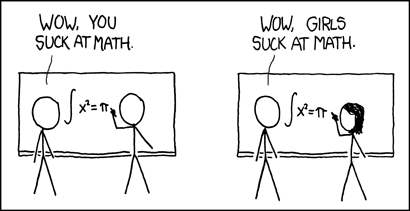
I like this comic because I see it happen a lot. I think it's pretty obvious these days when this sort of thing leads to sex stereotyping (as in the comic). As a teacher, particularly of math (the language of precision), I think it is very important for me to make sure this sort of thing doesn't happen in my classroom. Or in any other classroom for that matter. One person having or not having a particular ability has very little to do with anyone else's ability, even if the two share a commonality (e.g. sex, age, gender, hair color). It's important that I impress upon my students a way of thinking that encourages them to see where connections exist between two things and where they don't exist.
Friday, August 24, 2012
Organizing the Physical Classroom (Student Teaching Summary Post 6)
Oh finally the student teaching posts are over! Here's what I think is important where the physical classroom is concerned:
- Energy source Something for students to munch on if they're really needing it.
- Water
- Writing surfaces Students need some hard surface to write on.
- Community display This might be a wall or a smart/white/chalk board. It's a place where all kinds of information can be easily displayed for all to see.
- Teacher office space
- Movement space I think it's important to make sure there's plenty of room for people to move around the room.
- Coat rack You know, in case there're rainy coats to be hung.
- Absorbant rugs at entrances Again, rain kind of happens every once in a while here in Oregon. If there are no rugs at the entrances and exits, the floors will be very hazardous.
- Anonymous feedback system I want my students to have a way to let me know what's working for them and what's not working for them. I'd prefer it to be anonymous (not publicly displayed) so that I'm the only one who sees the comments. This is the kind of thing that I'll introduce on day 1 and then only every refer to again to let students know that I'm getting their feedback and making adjustments as necessary.
- Organizational system Things need a place to go. And they ought to be made to exist there. In my life, there is no room for exception to this. And I intend to ensure my classroom is a clean organized space at all times.
- Implication that the classroom extends beyond its physical bounds/connection between the classroom & the not classroom Something like a plant would be nice. Just something to remind students what they're fighting for.
I'm most excited about this list. I've never had my own classroom before and I'm pretty sure about 50% of this list is probably a really bad idea. I just don't know what 50% yet. Only time will tell....
Building Community in the Classroom (Student Teaching Summary Post 5)
Post 5 of 6 for my student teaching thoughts. These are my thoughts on building community in the classroom.
- Empathy Care about the students and their lives. They will reciprocate. After all, community is just a bunch of people all caring about the same things.
- Have students help build at least some of the classroom rules/regulations Giving students some control over the environment ought to give them ownership of the class. Feeling responsible for something helps build a sense of commitment and caring for that thing, which is the class in this case.
- Employ activity (e.g. physical movement, intellectual stimulation) that encourages students to get to know, care about, and trust one another If you have tips or hints on how to do this well, I welcome them in the comments.
- Be myself everyday I know full well that if I try to fake it, my students will know and resent me for it. Resentful students do not care about anything.
That's all I've got there. It's not very specific. I'm going to be working on coming up with some more concrete ideas as I go along: not ideal, I know but as good as it gets for now. Please let me know if you have any input on building community in a classroom.
Getting (& Keeping) Students on Task (Student Teaching Summary Post 4)
Here's a post detailing the thoughts I had as a student teacher concerning getting and keeping students on task.
- Do it again If students don't get a classroom behavior or expectation right the first time, show them what they did wrong, model how to do it write and have them do it again, until they get it right. This is a technique from Teach Like a Champion. I don't love everything in that book but this one I can get behind.
- Everyday: Remind students of upcoming homework and assessments, state the day's date, provide students with a daily agenda I think this is pretty important for keeping students focused on the task at hand.
- Employing group work:

The idea behind this graphic is that each student's desk (represented by rectangles) is positioned so that the student can have an easy to get to partner (blue elipse). Students can work mostly in partners. When needed, they can work in groups of four (red boxes). The pairs in each group may rely on each other for help during pair work, if they need to. During group work, neighboring groups can offer help to one another. The teacher is then only a support when several neighboring groups are stumped (or moving at very different speeds).
- Establish the purpose for the course early on (why should students care about what's happening in this course?) This is another important point for helping students find and keep their focus in class.
- Find out, at the beginning of the year/semester, what working algorithms (e.g. individual work time, group work, guided practice) work best for each class Some classes may work better with an emphasis on different types of work. It's good to have a little bit of all of these elements but maybe you have a little more of one then another if you know your class will work better that way.
- Provide specific, daily learning targets as well as unit-long learning targets Another focusing point.
There you have it. Some thoughts I had about time on task while student teaching.
- Do it again If students don't get a classroom behavior or expectation right the first time, show them what they did wrong, model how to do it write and have them do it again, until they get it right. This is a technique from Teach Like a Champion. I don't love everything in that book but this one I can get behind.
- Everyday: Remind students of upcoming homework and assessments, state the day's date, provide students with a daily agenda I think this is pretty important for keeping students focused on the task at hand.

The idea behind this graphic is that each student's desk (represented by rectangles) is positioned so that the student can have an easy to get to partner (blue elipse). Students can work mostly in partners. When needed, they can work in groups of four (red boxes). The pairs in each group may rely on each other for help during pair work, if they need to. During group work, neighboring groups can offer help to one another. The teacher is then only a support when several neighboring groups are stumped (or moving at very different speeds).
- Establish the purpose for the course early on (why should students care about what's happening in this course?) This is another important point for helping students find and keep their focus in class.
- Find out, at the beginning of the year/semester, what working algorithms (e.g. individual work time, group work, guided practice) work best for each class Some classes may work better with an emphasis on different types of work. It's good to have a little bit of all of these elements but maybe you have a little more of one then another if you know your class will work better that way.
- Provide specific, daily learning targets as well as unit-long learning targets Another focusing point.
There you have it. Some thoughts I had about time on task while student teaching.
Getting (& Keeping) Students' Attention (Student Teaching Summary Post 3)
Here's another short post. This one concerns things I want to implement in order to get and keep my students' attention.
- Routine (I find the routines are ways to get people to do things without them even having to think about it. Making routines routine in my classroom should help get my students' attention because they'll be expecting me to be getting their attention)
- Wait/Have patience (Waiting silently was probably the most effective way I found last year for getting my students' attention. They knew when they needed to quiet themselves down when I was just standing there waiting for them.)
These short posts are nice to write. Quick thoughts but well worth sharing, I think.
Wednesday, August 22, 2012
Grading (Student Teaching Summary Post 2)
This is going to be a pretty short post. Here's the very short list of things I want to make sure I'm doing concerning grading this coming year.
- Have an answer key or a very well written rubric to help make grading a mindless task
- When employing standards-based grading, make sure that essential skills (those that aren't covered by your standards) are still part of the curriculum
- Provide a rubric for feedback that is given to students (i.e. a rubric with which I can rate the quality of feedback that I'm giving students) side note: This may or may not be something that I tell my students about. Mostly I just want to make sure that I'm giving my students quality feedback.
That's it for grading. Told you it'd be short. As always, comments and feedback are super welcome.
Tuesday, August 21, 2012
Assignments, Assessments, & Evaluations (Student Teaching Summary Post 1)
Through the course of my student teaching experience, I had several ideas & epiphanies. Here are those that apply to assignments, assessments, & evaluations.
This table probably doesn't make a lot of sense if you're not me. So below I've put in a table that has some examples of what I'm thinking about. Let me know, in the comments, how it doesn't make sense, if it doesn't make sense, and I can further clarify. Also let me know if you want examples that are more specific to your needs.
- Hold office hours everyday to help with assignments:
+ Monday = for A-level students
+ Tuesday = for B-level students
+ Wednesday = for C-level students
+ Thursday = for D/F-level students
+ Friday = Peer tutoring sessions
+ Alternatively, provide some other meaningful structure for who should come and/or what is going to happen during the office hours.
- I really like an article by Margaret Schwan Smith and Mary Kay Stein called "Selecting and Creating Mathematical Tasks: from Research to Practice." It breaks all work that's done in a math class into four levels of demand: memorization, procedures without connections, procedures with connections, and doing mathematics. Their thoughts & ideas in this paper really guide my thinking about assignments, assessments, & evaluations. I find myself asking, 'What is the level of demand for this task? What ought to be the level of demand for this task? What level of demand are my students ready for at this point in the unit/semester/year?'
That pretty much sums up my thoughts about assignments, assessments, & evaluations. This was a long post. If you made it all the way through, FIVE STARS for you! Yea, STARS!
- Provide homework/practice before and after giving an assessment/evaluation for any given unit/standard
- Use the following table to put variety in student practice and assessment:
| Blooms | A) Easy | B) Medium | C) Hard |
|---|---|---|---|
1)
memorize
(only one correct response)
|
something easily memorized
OR
recognition (t/f)
| OR recognition (matching), recall (fill in the blank) |
difficult to memorize
OR
cold recall
|
2)
apply out of context
(likely one correct response)
|
simple practice problems
|
mid-level practice problems
|
high-level practice problem
|
3)
apply in context
(potentially multiple correct responses)
|
simple scenario/ story problem
(ala 2A) |
mid-level scenario/story problem
(ala 2B) |
high-level scenario/story problem
(ala 2C) |
4)
create/synthesize
(infinite possibilities for correct response)
|
making something simple
(ala 2A-2B) |
making something with moderate complexity
(ala 2C-3A) |
making something with high complexity
(ala 3B-3C) |
| Examples | Easy | Medium | Hard |
|---|---|---|---|
memorize
(only one correct response)
|
true/false, or multiple choice questions
|  |
Provide the definition for _________
|
apply out of context
(likely one correct response)
|
solve for x:
5-x=2 |
3x-2=4+5x-12
|
-3(12x-4)+7=12x+8(x+2)
|
apply in context
(potentially multiple correct responses)
|
Johnny has five apples before giving some to Tammy. Afterwards, Johnny has two apples. How many apples were given to Tammy
|
My backyard has a fence. The fence is 30 feet long and encompasses the whole yard. If my yard is a regular geometrical shape, what shape might it be if each side is > 2 feet?
|
Our school website says the school grounds covers 3,000 sq. ft. Prove that this is either correct or incorrect.
|
create/synthesize
(infinite possibilities for correct response)
|
create and solve an algebra problem
|
create a problem that requires the distributive property to solve
OR write a story problem to go with the equation y=3x-2 |
find an example of the concepts we've been covering in class from your life; write a story problem describing what you come up with
|
- Hold office hours everyday to help with assignments:
+ Monday = for A-level students
+ Tuesday = for B-level students
+ Wednesday = for C-level students
+ Thursday = for D/F-level students
+ Friday = Peer tutoring sessions
+ Alternatively, provide some other meaningful structure for who should come and/or what is going to happen during the office hours.
- I really like an article by Margaret Schwan Smith and Mary Kay Stein called "Selecting and Creating Mathematical Tasks: from Research to Practice." It breaks all work that's done in a math class into four levels of demand: memorization, procedures without connections, procedures with connections, and doing mathematics. Their thoughts & ideas in this paper really guide my thinking about assignments, assessments, & evaluations. I find myself asking, 'What is the level of demand for this task? What ought to be the level of demand for this task? What level of demand are my students ready for at this point in the unit/semester/year?'
That pretty much sums up my thoughts about assignments, assessments, & evaluations. This was a long post. If you made it all the way through, FIVE STARS for you! Yea, STARS!
Wednesday, August 15, 2012
Summary Thoughts From A Year of Student Teaching
So, though the summer has already come and gone, I think it's important for me to reflect on my student teaching experience in the 2011-2012 school year.
I spent the whole year student teaching in a Geometry class. Actually, I'm not going to talk much about that at all. Instead I'm going to take the next few blog posts to put down the things that I came up with as a student teacher, which I want to implement going forward. I've broken these things down into several categories. Maybe you find them useful. Maybe you find them interesting. At the very least I hope that they'll serve as some reference point for what I find important and what my priorities are as a math educator.
I'll put up one new post per category, as follows:
1) Assignments, Assessments, & Evaluation
2) Grading
3) Getting (& Keeping) Students' Attention
4) Getting (& Keeping) Students On Task
5) Building Community in the Classroom
6) Organizing the Physical Classroom
Some of these posts will probably be pretty long and some of them will probably be very short. I'm going to try to roll them all out by next Friday (8/24/2012).
Subscribe to:
Posts (Atom)